
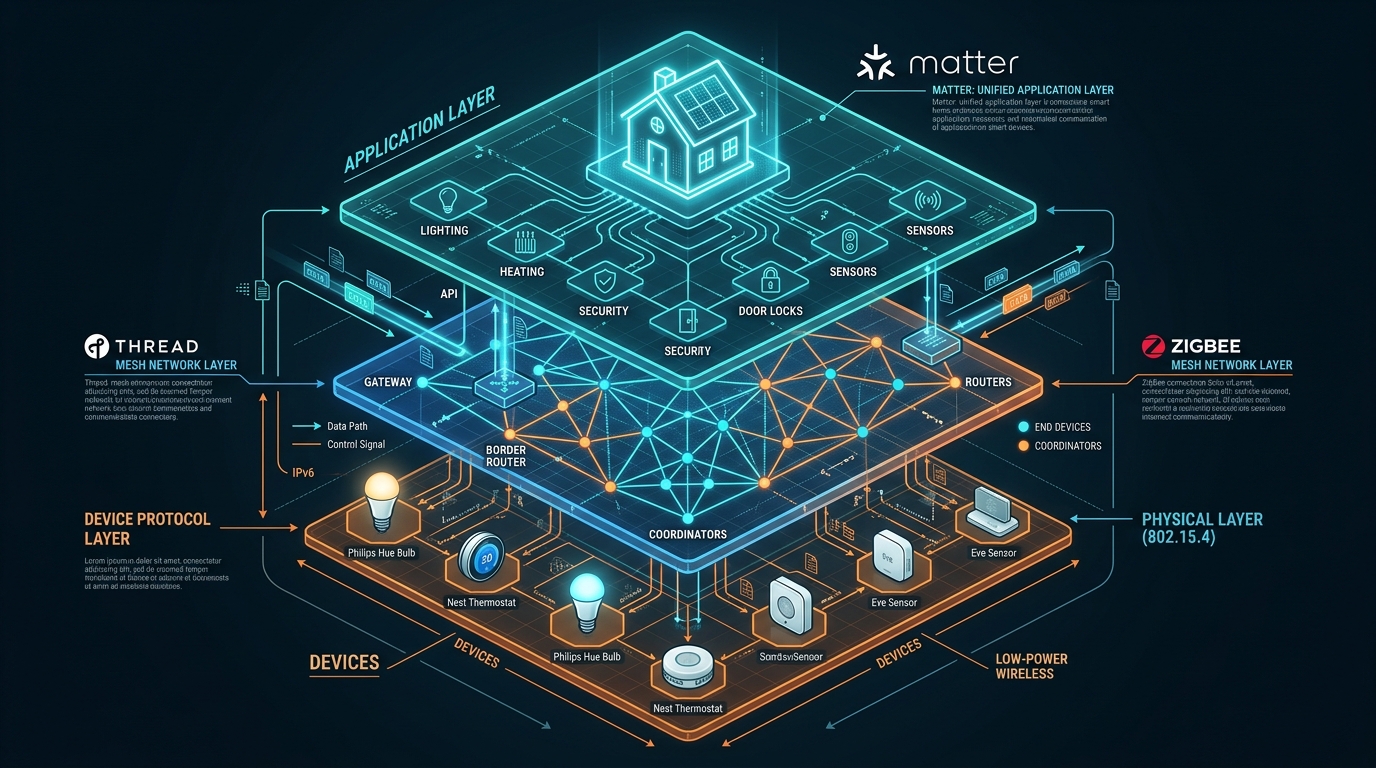
Matter, Thread, and Zigbee are not direct competitors — they operate at fundamentally different layers of the networking stack. Here is how each protocol actually fits into a smart home architecture in 2026.
A common point of confusion in home automation is deciding between Matter, Thread, or Zigbee. In reality, these three technologies operate across different layers of the network stack rather than directly competing for the same role.
Understanding how Application (Matter), Transport (Thread & Wi-Fi), and Full-Stack (Zigbee 3.0) protocols interact helps you build a responsive, local-first smart home.
1. The Layer Breakdown: Application vs Transport vs Full Stack
| Protocol Dimension | Matter (CSA) | Thread (Thread Group) | Zigbee 3.0 (CSA) |
|---|---|---|---|
| OSI Model Layer | Application Layer (Layer 7). Standardizes device schemas and commands. | Network / Transport (Layers 3–4). Low-power IPv6 mesh routing. | Complete Vertical Stack (Layers 1–7). Radio, mesh, and cluster library. |
| Underlying Radio | Radio-agnostic (Runs over Thread, Wi-Fi, Ethernet). | IEEE 802.15.4 wireless radio (2.4 GHz). | IEEE 802.15.4 wireless radio (2.4 GHz). |
| IP Addressability | Yes (Native IPv6 endpoints). | Native IPv6. Every node has a routable IPv6 address. | No (Uses 16-bit short network addresses via coordinator). |
| Multi-Admin Support | Native multi-admin across Apple, Google, Amazon, and Home Assistant. | Standardized border router sharing in Thread 1.4. | Single coordinator per PAN network. |
| Ecosystem Maturity | Maturing (Matter 1.4 specification). | Widely implemented in smart home hubs. | Extensive ecosystem with thousands of low-cost sensors. |
2. Matter: The Standardized Application Language
Matter is an application-layer standard managed by the Connectivity Standards Alliance (CSA). It defines data schemas and device controls so that an on/off switch or thermostat exposes identical commands regardless of whether it is commissioned in Apple Home, Google Home, or Home Assistant.
3. Thread: Low-Power IPv6 Mesh Networking
Thread is a secure, low-power IPv6 wireless mesh protocol developed by the Thread Group for battery-powered smart devices. Key features include self-healing mesh topology, dynamic leader election, and Thread Border Routers that connect the 802.15.4 mesh to your local Wi-Fi or Ethernet network.
4. Zigbee 3.0: The Proven Sensor Backbone
Zigbee 3.0 remains widely used for high-density sensor deployments (door/window contacts, temperature sensors, and presence devices like the ThirdReality R3). Paired with open-source coordinators on Home Assistant Green or the Sonoff NSPanel Pro, Zigbee offers low cost and multi-year battery life.
5. Strategic Protocol Blueprint for 2026
- Use Matter-over-Thread for: Smart door locks, smart plugs, and new lighting where multi-platform sharing is needed.
- Use Matter-over-Wi-Fi / Ethernet for: High-bandwidth devices, appliances, and spatial radar sensors like the Aqara FP2.
- Use Zigbee 3.0 for: Bulk battery-powered sensor setups managed locally via Zigbee2MQTT or ZHA.
- Use Local Hubs for: Coordinating all devices into a unified local automation system with optional on-device NPU processing.
Related Architecture Guides:
• Thread 1.4 Released: Unified Border Routing and Multi-Vendor Mesh Sharing
• Matter 1.4 Specification Released: Multi-Admin Sync & HEMS Energy
• Home Assistant Green: Entry-Level Smart Home Hub Overview
• ThirdReality R3 Smart Presence Sensor Hands-On Review
• Aqara Presence Sensor FP2: Multi-Zone mmWave Radar Guide
• mmWave Radar vs Passive Infrared: Sensor Technology Guide
0 Comments