
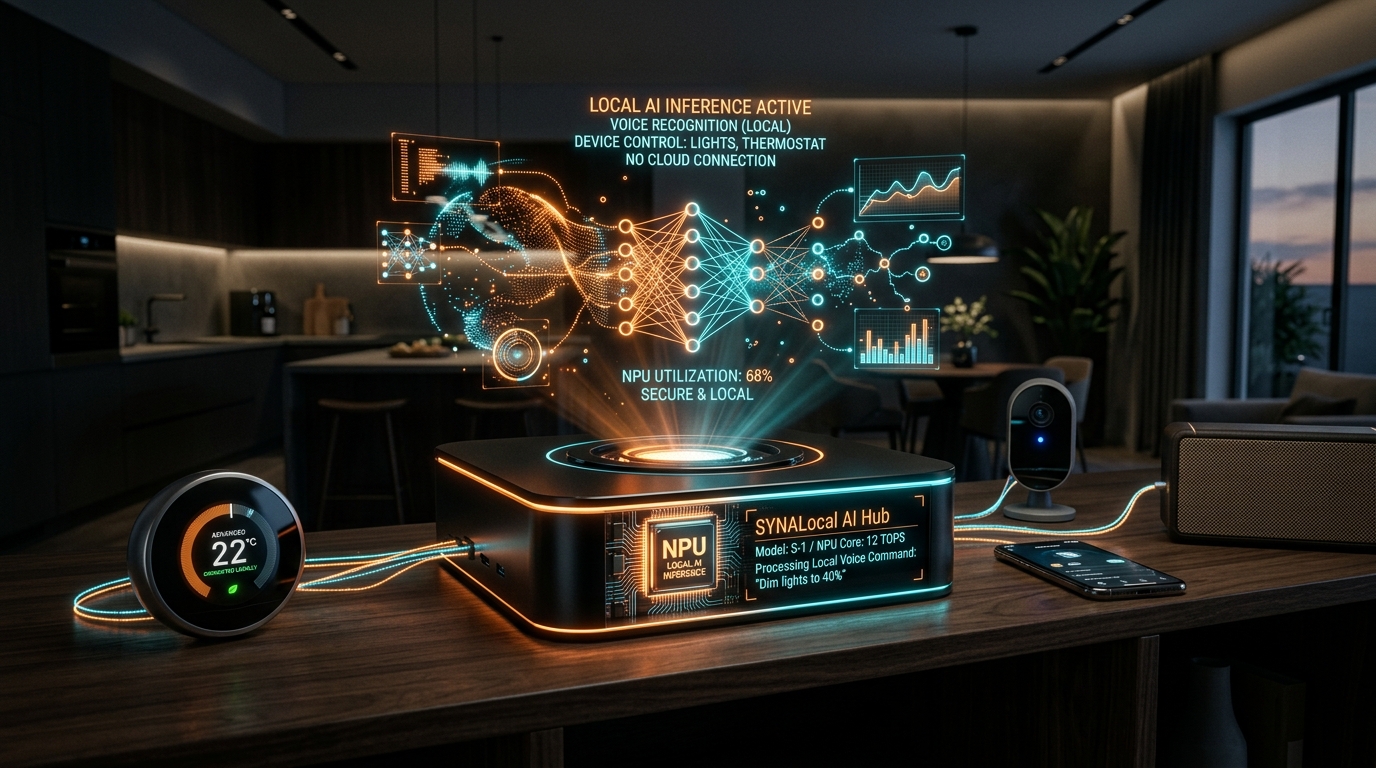
Why dedicated Neural Processing Units (NPUs) and on-device language models are transforming residential automation hubs from cloud-dependent relays into autonomous local computing engines.
For more than a decade, consumer voice automation followed a centralized cloud paradigm. When you spoke a command to an Amazon Alexa or Google Assistant speaker, your unencrypted voice audio was digitized, compressed, and streamed across the public internet to remote data centers for Speech-to-Text (STT), Natural Language Understanding (NLU), and Text-to-Speech (TTS) synthesis.
While this architecture lowered initial speaker manufacturing costs, it introduced three major compromises: latency delays (often 1.5 to 4 seconds round-trip), automation failure during internet or cloud outages, and domestic privacy risks. In 2026, the convergence of high-efficiency Neural Processing Units (NPUs) and quantized Small Language Models (SLMs) makes fully offline, on-device voice processing practical for modern smart homes.
1. The Cloud Architecture Dilemma: Latency, Subscriptions & Outages
The economic model behind cloud voice assistants has shifted significantly. Maintaining millions of real-time inference requests across remote GPU clusters requires substantial recurring server infrastructure. To manage these costs, major platforms have increasingly introduced subscription paywalls, added promotional messaging, or deprecated older hardware integrations.
Furthermore, cloud-based voice processing introduces network latency. An on-device smart hub like Home Assistant Green executing local Zigbee or Matter commands switches a light in under 50 milliseconds. Routing that same request through external cloud servers adds DNS lookups, TLS handshakes, and remote queue processing, stretching response times to multiple seconds.
2. Understanding Smart-Home NPUs: Architecture & Hardware Acceleration
A Neural Processing Unit (NPU) is a specialized silicon accelerator optimized specifically for the matrix multiplication, convolutions, and tensor activations (INT8, INT4, FP16) that power neural networks.
While traditional CPU cores (such as ARM Cortex-A55) execute instructions sequentially and draw higher power when computing transformer attention layers, an NPU performs parallel tensor math with high power efficiency:
| Hardware Accelerator | Manufacturer Rating | Typical Power | Target Smart-Home Workload |
|---|---|---|---|
| Raspberry Pi AI HAT+ (Hailo-8L) | Rated at 13 TOPS (INT8) | ~1.5W – 2.0W | Vision inference (Frigate NVR person/object detection) and Whisper speech-recognition models compiled for the Hailo accelerator. |
| Hailo-8 M.2 Module (Full) | Rated at 26 TOPS (INT8) | ~2.5W | Multi-stream video analytics, advanced object classification, and acoustic model acceleration. |
| Rockchip RK3588 (Tri-Core NPU) | Rated at 6 TOPS (INT8/INT4) | ~3.0W – 5.0W (SoC) | Integrated edge gateway processing, RKLLM lightweight model inference, and local intent pipelines. |
| Intel N100 (x86 Quad-Core CPU) | CPU / iGPU compute | ~6.0W – 15.0W | General Home Assistant server running CPU-based Faster-Whisper STT, Piper TTS, and Ollama SLMs. |
Note on Hardware Demarcation: Accelerators like the Hailo-8 and Hailo-8L are engineered specifically for convolutional neural networks (CNNs) and vision/audio inference. For generative large language models (LLMs), workloads are typically handled by host x86/ARM CPUs (via llama.cpp/Ollama), RK3588 NPUs (via RKLLM), or dedicated generative accelerators like the Hailo-10H.
3. On-Device Small Language Models (SLMs) in Practice
The development enabling local smart homes to understand conversational speech is model quantization. By compressing model weights from 16-bit floating point down to 4-bit integers (INT4 / GGUF format), compact language models (1 billion to 3.8 billion parameters) can run within 2 GB to 4 GB of system memory.
Models commonly utilized in local home automation setups include:
- Google Gemma 2 (2B): A compact reasoning model capable of structured JSON function calling, allowing the local hub to translate conversational speech into specific entity service calls.
- Microsoft Phi-3.5 Mini (3.8B): Suitable for multi-step logic and contextual memory, executing on local mini-PCs and capable edge hardware.
- Qwen 2.5 (1.5B / 3B): A lightweight multilingual model capable of running with sub-200ms token generation times on modern host CPUs.
- Hassil (Home Assistant Native Intent Parser): A deterministic grammar-based intent parser executing in under 5 milliseconds on low-power hardware without requiring neural model inference for standard commands.
4. The Complete Offline Voice Pipeline: Wake Word to Audio Return
A modern local voice automation setup decouples the physical microphone from the compute engine using the open-source Wyoming Protocol:
Step 1 – Local Wake Word: A low-power audio satellite (such as an ESP32-S3 Voice Satellite) runs microWakeWord directly on its dual-core microcontroller. No audio is transmitted over the network until the wake word is detected.
Step 2 – Stream to Local Host: Upon wake-word detection, raw 16kHz PCM audio streams over the local network to your home server.
Step 3 – Local Speech-to-Text (Faster-Whisper): The server transcribes the audio using OpenAI’s Whisper model (typically tiny-int8 or base-int8) running on the local host in 100 to 250 milliseconds.
Step 4 – Intent Resolution: The intent engine parses the transcribed text, issues the local Matter, Thread, or Zigbee command, and confirms execution.
Step 5 – Neural Text-to-Speech (Piper): If spoken feedback is requested, Piper neural TTS generates audio in ~150 milliseconds and streams the playback back to the satellite speaker.
5. Architectural Summary & Privacy Boundary
The transition to NPU-assisted edge computing provides sub-second voice latency and keeps household audio and presence telemetry entirely within the local home network, eliminating reliance on remote cloud infrastructure.
Related Technical Guides:
• Local Voice Satellites: Building Offline Microphones with ESP32-S3 and Whisper
• Home Assistant Green: Entry-Level Smart Home Hub Overview
• Matter vs Thread vs Zigbee in 2026: Multi-Protocol Architecture Guide
• mmWave Radar vs Passive Infrared: Sensor Technology Guide
0 Comments