
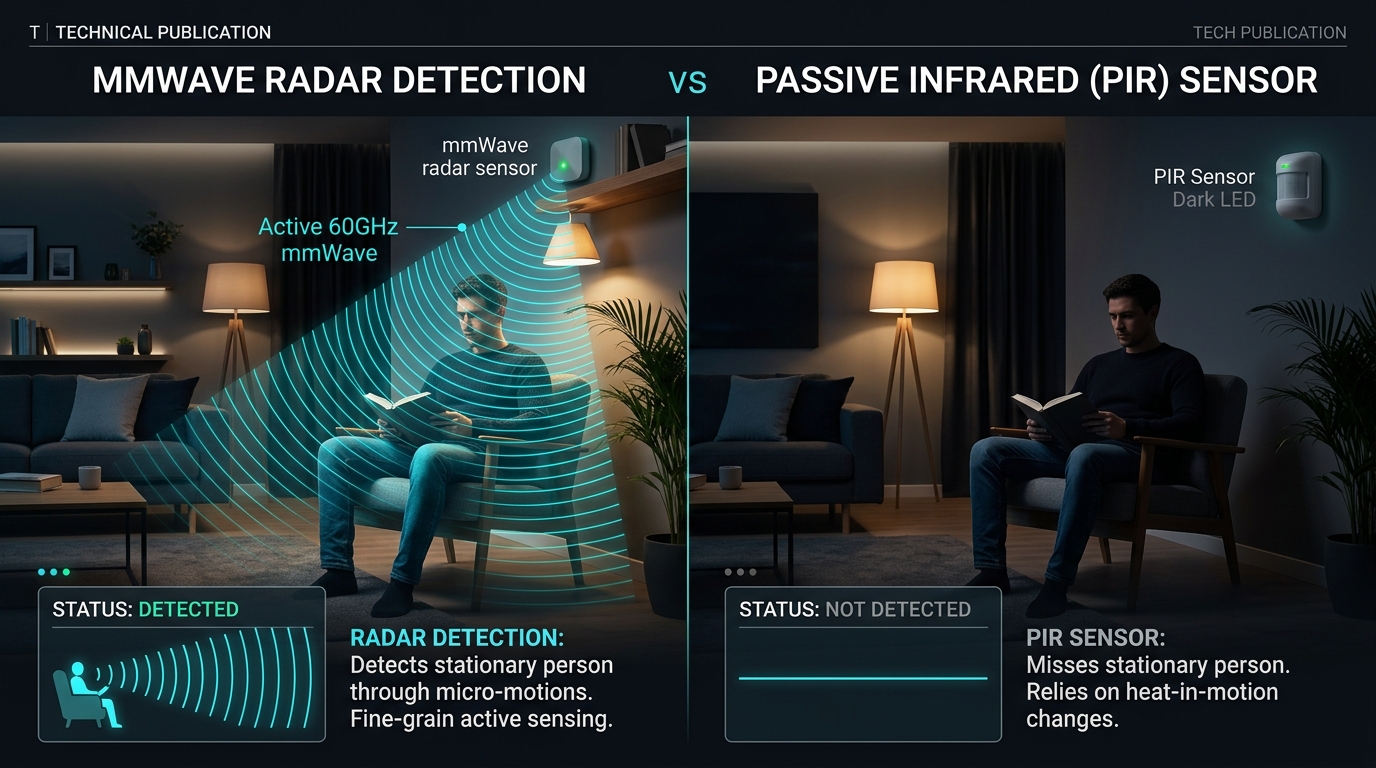
Understanding the detection physics, installation considerations, and deployment trade-offs between millimeter-wave radar presence detection and passive infrared motion sensors.
For decades, residential automation systems relied almost exclusively on Passive Infrared (PIR) sensors for automated lighting, climate routines, and security monitoring. While inexpensive and energy-efficient, PIR sensors are designed to detect gross motion rather than static occupancy. If an occupant sits quietly reading or working at a desk, a PIR sensor eventually times out.
The development of consumer millimeter-wave (mmWave) radar sensors has introduced a powerful complement to traditional PIR. Operating at high frequencies (typically 24 GHz or 60–64 GHz), mmWave sensors detect micro-movements, including the subtle chest displacement from respiration. Here, we examine the physics, practical trade-offs, and hybrid deployment strategies for both technologies.
1. Physics of Detection: Doppler Shift vs Pyroelectric Infrared
The operational difference between PIR and mmWave stems directly from the physics of electromagnetic and thermal detection:
| Engineering Dimension | Passive Infrared (PIR) | Millimeter-Wave Radar (mmWave) |
|---|---|---|
| Operating Principle | Passive detection of infrared thermal radiation (~10 µm) through a segmented Fresnel lens onto pyroelectric elements. | Active transmission of electromagnetic radio waves; measures Doppler frequency shift and phase displacement of reflected signals. |
| Static Human Presence | Requires ongoing physical movement across optical beam sectors; cannot detect motionless occupants. | Detects micro-movements, including subtle thoracic displacement from breathing. |
| Spatial & Distance Tracking | Binary trigger only (motion detected / clear within broad field of view). | Continuous distance measurement, approach/departure direction, and (on multi-antenna arrays) X/Y coordinate tracking. |
| Power Consumption | Ultra-Low Power (10–30 µA). Operates on a single coin cell battery for 2 to 5 years. | Moderate Power (150–500 mW). Continuous RF transmission and DSP processing typically require 5V USB-C or mains power. |
| Detection Profile | PIR can provide rapid motion detection upon entering an optical beam sector. | mmWave maintains continuous occupancy detection even when a person remains relatively still. |
| Material Penetration | Blocked by glass, standard plastics, and solid surfaces. | Penetrates drywall, thin wood, curtains, and glass shower doors. |
2. Radar Frequency Bands: 24 GHz vs 60–64 GHz
Consumer presence hardware is generally split between two frequency bands:
24 GHz Radar (Industrial ISM Band): Commonly used for economical single-zone presence detection up to 6 meters. Its beam profile is well-suited for basic room presence sensing where granular spatial coordinate tracking is not required.
60–64 GHz Radar (Wideband mmWave): Used in sensors such as the ThirdReality R3 and Aqara Presence Sensor FP2. The wider bandwidth (~4 GHz bandwidth vs ~250 MHz on 24GHz) provides higher spatial resolution and fine micro-movement tracking (as documented in industrial mmWave radar engineering whitepapers).
3. Managing False Positives & RF Reflections
Because mmWave radar is sensitive to micro-movements, deployment requires managing potential interference sources:
- Ceiling Fans and HVAC Vents: Rotating fan blades or air currents moving nearby objects produce Doppler frequency shifts that radar algorithms may detect as movement. High-end sensors allow setting exclusion zones to mask specific coordinates.
- Curtains and Moving Plants: Draft-induced curtain movement or outdoor foliage swaying outside a window can reflect radar signals through glass.
- Through-Drywall Penetration: Radar waves pass through standard interior drywall. A sensor placed on an interior wall may trigger from motion in an adjacent room unless maximum detection range is restricted.
- Multipath Reflections: Radio waves reflecting off large mirrors or metallic appliances can create secondary target detections. Proper mounting angles help minimize these artifacts.
4. The Complementary Architecture: PIR + mmWave Integration
Rather than replacing PIR entirely, smart home systems often combine both sensor types in complementary roles:
Rapid Initial Trigger (PIR): PIR motion sensors provide fast, ultra-low-power triggering for lighting upon room entry.
Continuous Presence Hold (mmWave): Once triggered, the radar continuously monitors micro-Doppler reflections from respiration, keeping the presence entity active in Home Assistant or Apple HomeKit while the room remains occupied.
Prompt Timeout: Once the occupant leaves, the radar confirms the absence of micro-movement, allowing a short timeout (e.g. 15 to 30 seconds) rather than the long timeout delays required by standalone PIR sensors.
5. Practical Deployment Guidelines
- Use Battery PIR for: Hallways, staircases, closets, and transit areas where movement is continuous and multi-year battery life is preferred.
- Use mmWave Presence Sensors for: Home offices, bathrooms, and bedrooms where single-zone stillness must be maintained.
- Use 60GHz Multi-Zone mmWave for: Open-concept living areas and kitchens where multiple sub-zones (such as a desk, sofa, or dining area) require independent triggers.
Related Hardware & Architecture Guides:
• ThirdReality R3 Smart Presence Sensor Hands-On Review
• Aqara Presence Sensor FP2: Multi-Zone mmWave Radar Guide
• Matter vs Thread vs Zigbee in 2026: Multi-Protocol Architecture Guide
• Home Assistant Green: Entry-Level Smart Home Hub Overview
0 Comments