
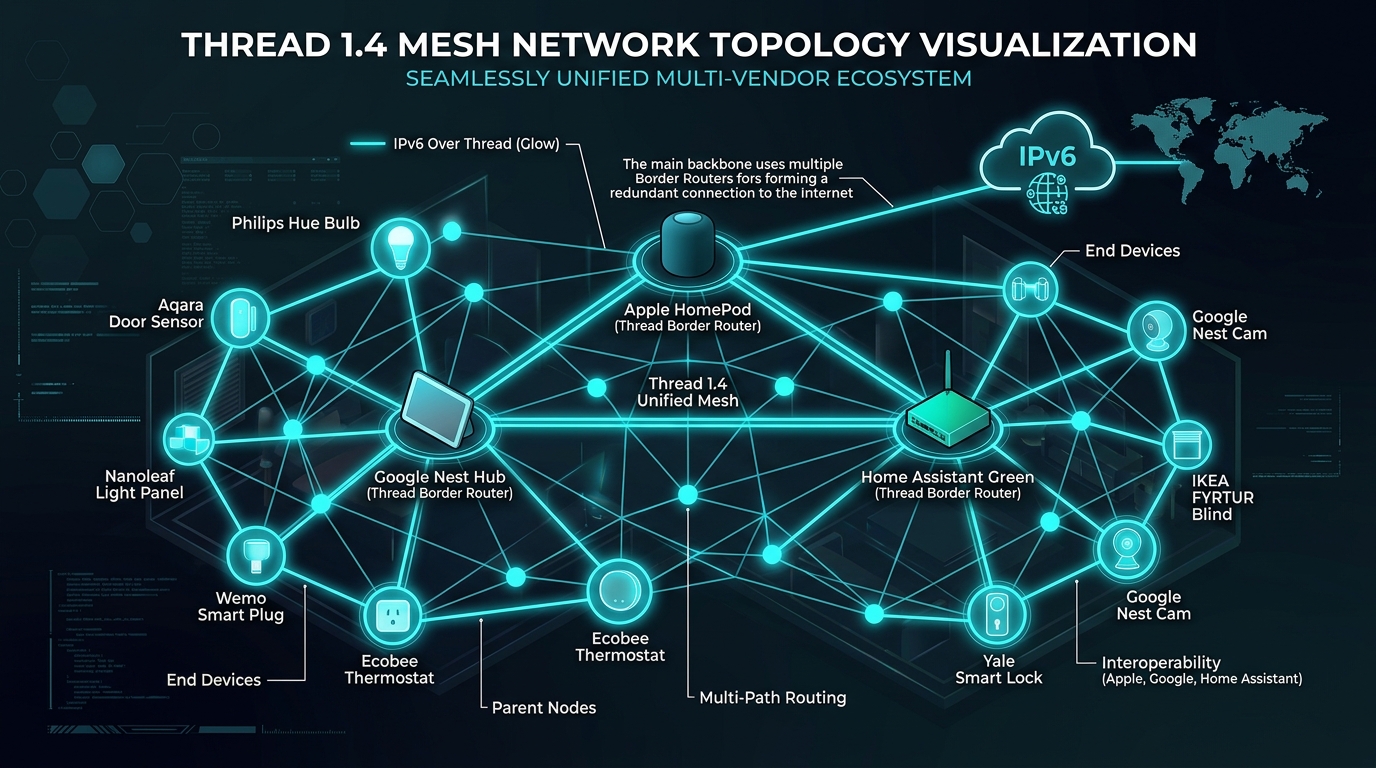
The Thread Group has finalized the Thread 1.4 wireless networking standard, standardizing multi-vendor border router credential sharing and eliminating split mesh networks across smart homes.
Since the rollout of Matter-over-Thread, smart home users have occasionally encountered split Thread meshes: when commissioning devices across Apple, Google, and Home Assistant border routers, hardware could become divided across separate PAN networks rather than forming a single, unified mesh.
With the release of the Thread 1.4 specification by the Thread Group, this architectural issue is formally addressed. Thread 1.4 standardizes how Thread Border Routers (TBRs) discover each other, securely share network credentials, and merge into a single self-healing IPv6 wireless network.
1. The Split Mesh Problem & Thread 1.4 Enhancements
In Thread 1.3 and earlier versions, there was no standardized protocol for a border router from one manufacturer to discover and securely join the operational dataset of an existing Thread mesh created by another brand. Thread 1.4 introduces standardized Border Agent Credential Sharing over the local network backbone:
| Protocol Capability | Thread 1.3 Architecture | Thread 1.4 Specification |
|---|---|---|
| Multi-Vendor Border Routing | Fragmented meshes; manual credential sharing across mobile OS APIs. | Standardized Mesh Unification. Standardized mDNS discovery and mutual TLS credential exchange merge border routers into a single mesh. |
| Thread Over Infrastructure | Limited standardized routing between separated mesh segments. | Native IPv6 routing across home LAN backbones bridges out-of-range mesh zones. |
| Commissioning Range | Bluetooth Low Energy (BLE) proximity required for onboarding. | Over-the-Air Commissioning. Allows pre-authenticated devices to join the Thread mesh directly over 802.15.4 radios. |
| Diagnostic Telemetry | Proprietary vendor diagnostic formats. | Standardized diagnostic Type-Length-Value (TLV) metrics for link quality and node telemetry. |
2. Thread over Infrastructure & Multi-Story Deployments
In large homes or structures with reinforced walls, 2.4 GHz IEEE 802.15.4 signals may not easily penetrate between floors. Thread 1.4 introduces Thread over Infrastructure, allowing border routers connected to the same home Ethernet or Wi-Fi network to route inter-device traffic across the wired LAN backbone as a single logical network.
3. Synergy with Matter 1.4 Enhanced Multi-Admin
Thread 1.4 operates in close coordination with the Matter 1.4 specification:
- Transport Layer (Thread 1.4): Ensures battery-powered sensors, door locks, and presence sensors communicate over a single, resilient IPv6 mesh.
- Application Layer (Matter 1.4): Uses Enhanced Multi-Admin (EMA) so devices on that unified mesh can be shared across Apple Home, Home Assistant, and Google Home without repetitive pairing codes.
4. Ecosystem Rollout & Backward Compatibility
Thread 1.4 maintains backward compatibility with existing Thread 1.3 and 1.2 end-devices. Existing hardware does not require replacement; it benefits from the expanded routing and coverage provided by Thread 1.4 border routers as platform manufacturers release OpenThread stack firmware updates.
Related Standards Guides:
• Matter 1.4 Specification Released: Multi-Admin Sync & HEMS Energy
• Matter vs Thread vs Zigbee in 2026: Multi-Protocol Architecture Guide
• Home Assistant Green: Entry-Level Smart Home Hub Overview
• mmWave Radar vs Passive Infrared: Sensor Technology Guide
0 Comments