
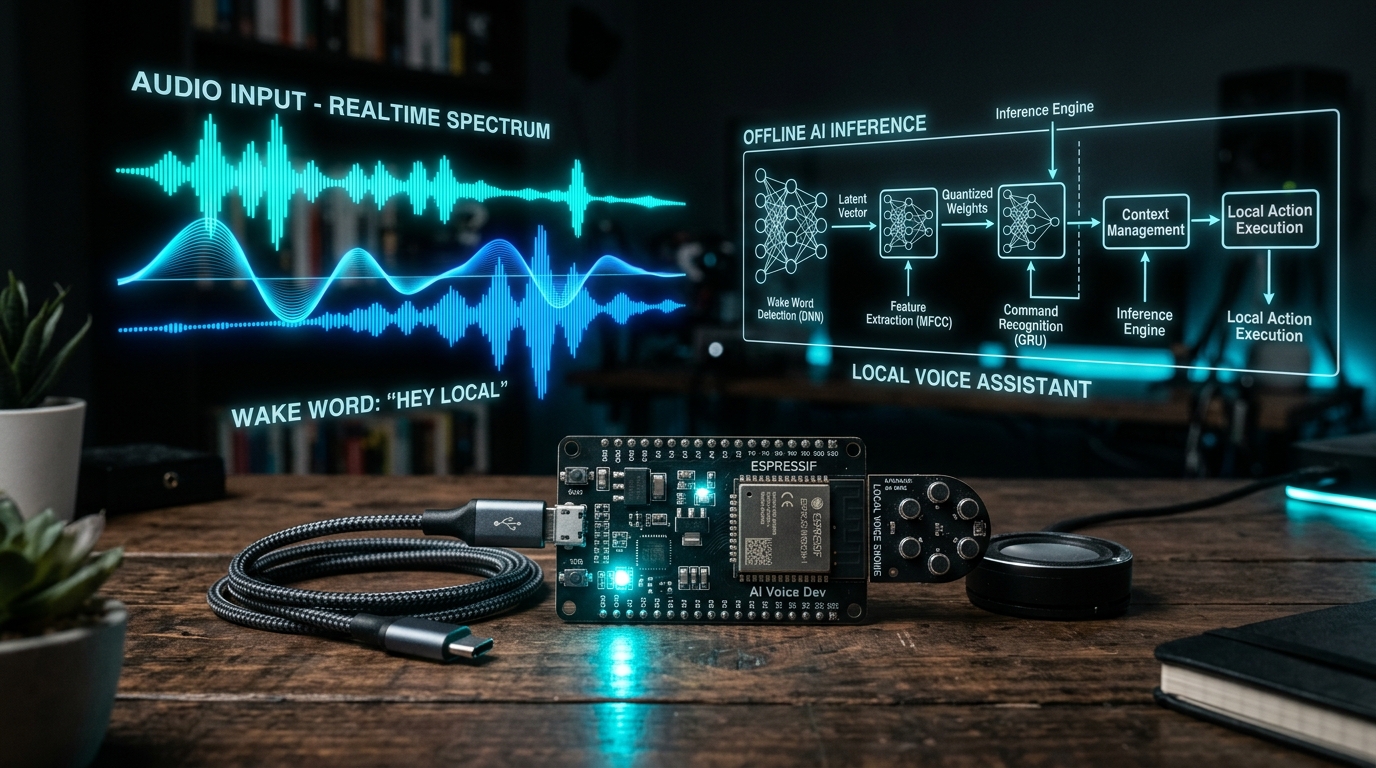
How Espressif’s ESP32-S3 microcontroller, the open-source Wyoming protocol, and Whisper neural transcription enable private, low-latency voice automation satellites without cloud audio streaming.
Building private, local voice control without commercial cloud assistants has traditionally required dedicated mini-PCs in every room. The combination of Espressif’s ESP32-S3 silicon, the open-source Wyoming protocol, and centralized local server inference enables compact, affordable room-by-room voice satellites.
In this technical guide, we break down the hardware specifications, acoustic considerations, and software pipeline required to deploy local voice satellites across your home.
1. Silicon Architecture: Why the ESP32-S3 is Suited for Voice Satellites
According to Espressif documentation, the ESP32-S3 features specific architecture advantages for edge audio:
| Hardware Feature | ESP32-S3 Specification | Voice Satellite Role |
|---|---|---|
| CPU Architecture | Dual-core 32-bit Xtensa LX7 @ up to 240 MHz. | Separates networking tasks from audio DSP and wake-word neural evaluation. |
| Vector Extensions | SIMD vector instructions for accelerated tensor math. | Enables microWakeWord neural models to run locally with low CPU overhead. |
| Memory Configuration | 512 KB internal SRAM + up to 8 MB Octal PSRAM. | Provides circular audio ring buffers for pre-roll capture and DSP processing. |
| Digital Audio I/O | I2S (Inter-IC Sound) digital audio interfaces. | Direct interface to digital MEMS microphones (INMP441) and I2S DAC amplifiers (MAX98357A). |
2. Hardware Deployment Options
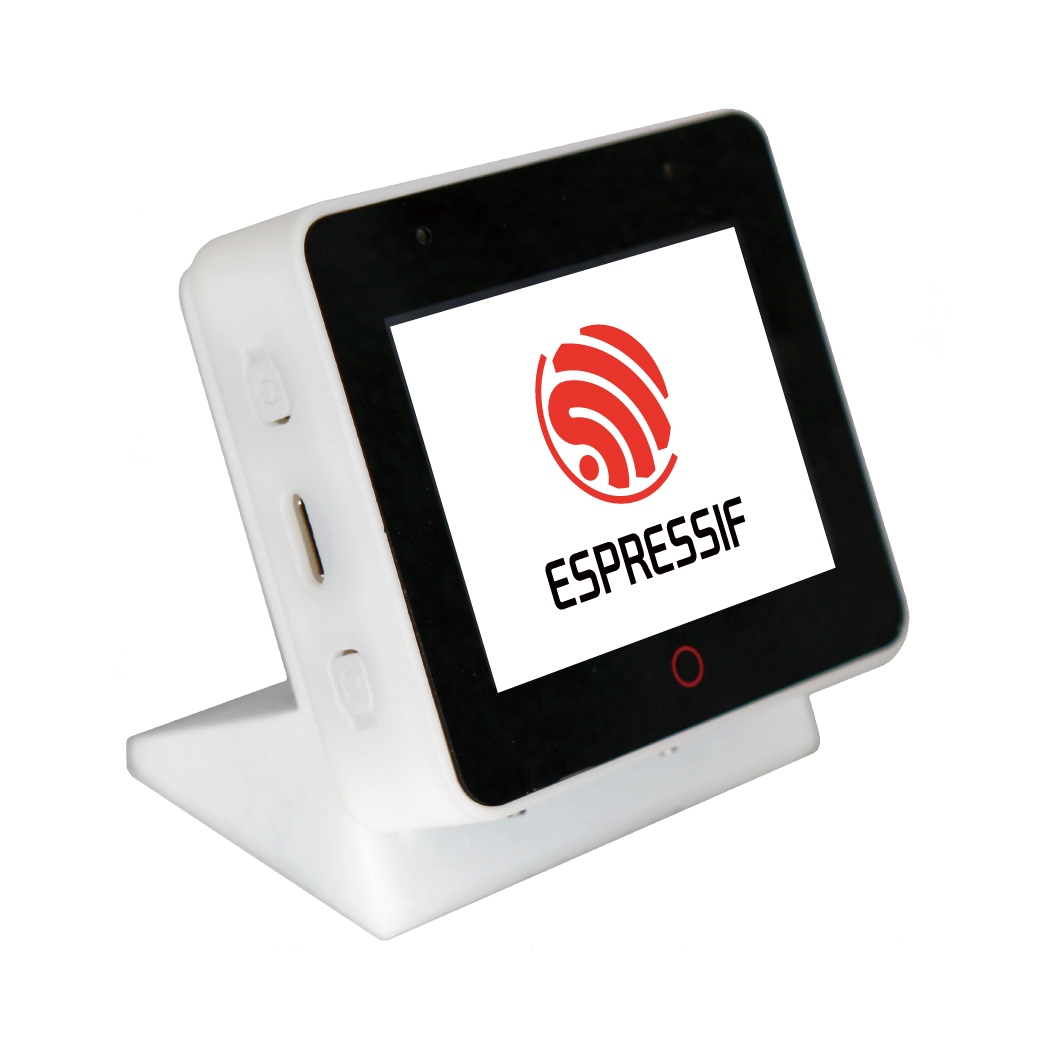
Fig 1. Official Espressif ESP32-S3-BOX hardware development unit featuring dual MEMS microphones, integrated acoustic echo cancellation, and 2.4-inch display.
- Espressif ESP32-S3-BOX-3: A pre-built development kit with dual MEMS microphones, hardware acoustic echo cancellation, a 2.4-inch touchscreen display, onboard speaker, and mute switch. Supported natively by ESPHome and Home Assistant.
- M5Stack Atom Echo: A compact satellite housing an ESP32-S3, miniature microphone, and small speaker for discreet room placement.
- Custom DIY Builds: Built using an ESP32-S3 board paired with an INMP441 I2S microphone and a MAX98357A amplifier driving a 4-ohm speaker.
3. The Wyoming Voice Architecture: 4-Stage Pipeline
The core design principle is decoupling audio capture from compute-heavy transcription. The satellite acts as an audio streaming endpoint via the Wyoming Protocol:
Stage 1 – On-Device Wake Word: The ESP32-S3 continuously samples the microphone into a local circular buffer. An embedded neural model (microWakeWord) evaluates the audio stream locally. No network traffic is generated during this idle state.
Stage 2 – Local Network Streaming: Upon wake-word detection, the satellite opens a connection over local Wi-Fi to the central Home Assistant server, streaming raw 16kHz PCM audio.
Stage 3 – Neural Speech-to-Text: The server transcribes the stream using Faster-Whisper (typically running tiny-int8 or base-int8 models on the host CPU or NPU) in 100 to 200 milliseconds.
Stage 4 – Intent Execution & Voice Synthesis: Home Assistant’s native Hassil intent parser processes the command, executes the local Matter or Zigbee action, and generates spoken confirmation via Piper neural TTS.
4. Acoustic Echo Cancellation (AEC)
To allow the satellite to hear wake words while audio is actively playing through its speaker, the ESP32-S3 routes the playback signal back into the DSP algorithm via a hardware reference channel. The DSP subtracts the known playback waveform from the microphone input, maintaining wake-word sensitivity during playback.
Related Technical Guides:
• Local AI in Smart Homes: Why NPU-Equipped Hubs Are Replacing Cloud Voice
• Home Assistant Green: Entry-Level Smart Home Hub Overview
• Matter vs Thread vs Zigbee in 2026: Multi-Protocol Architecture Guide
• Sonoff NSPanel Pro: Smart Wall Controller & Local Bridge Architecture
0 Comments